

Eight Layers of Security: How SwissBorg Keeps Your Crypto Safer



Dan Stokes
Community Growth
You have read the headlines. Another exchange, another theft, another week of asking the same quiet question: is my crypto where it should be?
It is a fair question to ask of any platform, and it deserves a straight answer rather than reassurance.
So here is an honest one. No platform can promise that nothing will ever go wrong. What a platform can do is make sure no single failure puts your crypto at risk. At SwissBorg, that means eight layers of security, backed by further checks behind the scenes: two layers we built, three you control and three that others can verify.
You should not need to be a security engineer to understand any of them. Here they are, in plain words.
Why One Layer Is Never Enough
Picture a vault. Most people imagine thieves cracking the lock. The largest thefts rarely touch it. They go after the people who hold the keys to the door.
Most large exchange hacks do not break the cryptography that protects private keys. They rely on social engineering: tricking someone with access into opening a door they should not, then working through a company's systems until they reach the software that moves funds. The Bybit theft in February 2025 and the Binance theft in October 2026 both followed this pattern.
Strong locks matter. What also matters is what is checked before the door opens, and what still stands if one safeguard fails.
That is why no single layer carries the whole load at SwissBorg. If one is tested, the others still stand.
The Eight Layers That Keep Your Crypto Safer

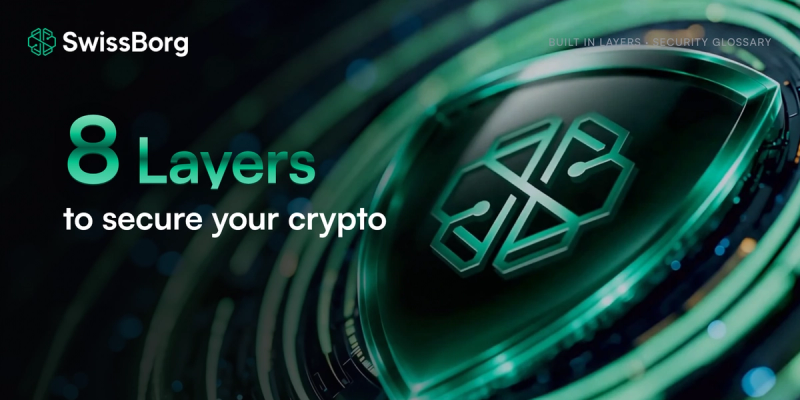
Each layer answers one question you might ask of any platform. Here is the answer at SwissBorg, in plain words. For the full detail, see how SwissBorg protects your assets.
Built by us: 1. Custody, 2. MPC security
Controlled by you: 3. Mobile device security, 4. Scam prevention, 8. Withdrawal protection
Verified by others: 5. Proof of liabilities, 6. Security testing, 7. Regulation
Layer 1: Custody
If the platform went bust tomorrow, would your crypto be frozen with it? At SwissBorg, your crypto stays your property and is kept apart from ours.
Your crypto is held by BlockNodes SAS, our entity in France, authorised by the AMF under MiCA. It sits on different wallet addresses from the company's own crypto, with separate legal and accounting records, and would not form part of BlockNodes' estate if it ever became insolvent. A ledger, updated in real time and regularly checked against the blockchain, records each user's balance.
Exchange hot wallets are a favourite target, so only a small share of users' crypto is held with exchanges, to execute orders, and only with exchanges that are themselves authorised under MiCA. The SwissBorg Meta-Exchange draws liquidity from more than 40 venues, so trades can be routed elsewhere if one of them has a problem.
Layer 2: MPC Security
Is there a single key to steal? No. The full key never exists in one place.
The keys are protected with multi-party computation (MPC) technology from Fireblocks, and from Cordial Systems for assets Fireblocks does not support. Each private key is split across several independent systems, so no single party, not a technology provider and not our own team, can use it alone. These providers supply the technology; BlockNodes SAS remains the custodian.
Before anything is signed, a policy engine checks the transaction against rules we set. Some transactions are approved automatically, others need a person to approve them, and changing the rules needs approval too.
Layer 3: Mobile Device Security
If your password leaked tomorrow, could a stranger get into your account? Not without your phone and your separate account PIN.
When you set up the app, your phone creates a device key that never leaves it, and every sign-in and sensitive action is signed with that key. Sign-ins and withdrawals also need your unique PIN or passphrase, and too many wrong attempts lock the account. Moving to a new phone takes your passkey and your PIN.
After a manual account recovery or a change of phone number or email, withdrawals pause for 48 hours, and we email you about each change, so you can report it if it was not you.
More on mobile device security
Layer 4: Scam Prevention
Would you spot a fake support agent before your money moved? Every genuine call is announced in the app first.
Before anyone from our team calls you, the app sends a push notification with their name (Call Authenticator). Treat a call, SMS or WhatsApp message without that notification as fraudulent.
Scammers pretend to be SwissBorg, and sometimes a regulator, with the same story: your account has been breached and your funds must be moved to a "safe" wallet. SwissBorg will never ask you to move, withdraw or "secure" your funds, and will never ask for your recovery phrase, PIN or verification codes. If anything feels wrong, stop, hang up and contact us through in-app Support.
Layer 5: Proof of Liabilities
Can you check that your balance is really counted? Yes, yourself, every month.
Every month we publish an audit of anonymised user balances. Find your Audit Credential ID in the Security section of the app and enter it on our self-verification page to check that your own balance is included, without sharing any personal data. The code is open source on GitHub. Read how Proof of Liabilities works.
Layer 6: Security Testing
Who finds the weak spots first: outside experts or criminals? We make sure it is the experts.
As a MiCA-authorised provider, BlockNodes SAS must meet the EU's Digital Operational Resilience Act (DORA), which requires regular testing. Our security team runs continual internal security audits, and an independent firm carries out external penetration tests. Spotted an issue yourself? Email security@swissborg.com.
Layer 7: Regulation
Who checks that we follow the rules? The AMF, France's financial markets regulator.
BlockNodes SAS, our entity in France, is authorised and supervised by the Autorité des marchés financiers (AMF), France's financial markets regulator, as a crypto-asset service provider under MiCA, licence A2026-011. Its authorisation covers custody and administration of crypto-assets, among other services. Our relationship with the AMF goes back further than MiCA: SwissBorg was first registered as a PSAN (digital asset service provider) with the AMF in April 2022, through another SwissBorg group entity, years before MiCA applied across the EU. Under MiCA, BlockNodes is liable to you for the loss of any crypto-asset where the loss is attributable to it; events on public blockchains it does not control are excluded. Full details are in our Custody Policy summary.
Layer 8: Withdrawal Protection
If someone forced you to send your crypto right now, what would stop them? A waiting time that you chose.
Choose a delay of 1 to 180 days on every crypto withdrawal and on Smart Send. It cannot be shortened or lifted early, not even by our support team. Settings are quick to tighten and slow to loosen: a longer delay or a lower allowance applies at once, while a shorter delay, a higher allowance or turning protection off waits your full delay, so forcing you to change them gains an attacker nothing. Buying, selling and exchanging in the app work as usual. An optional allowance lets everyday amounts go out straight away, up to a total you set for a rolling 24 hours, 7 days or 30 days, shared across crypto withdrawals and Smart Sends. Anything above it waits your delay. Withdrawal Protection is off by default, and we recommend switching it on.
Built by us. Controlled by you. Verified by others.
Why MiCA Authorisation Matters for Your Crypto

Since 1 July 2026, any company offering crypto services to people in the EU needs authorisation under MiCA, the EU's Markets in Crypto-Assets Regulation. It is not a badge. It sets out what a custodian must do with your crypto, and what it must never do:
- Keep your crypto separate. Client crypto sits on different wallet addresses from the company's own, with separate legal and accounting records, and does not form part of the company's estate if it becomes insolvent.
- Never use your crypto for itself. Your crypto-assets remain your property, and a custodian cannot use them for its own account without your explicit consent.
- Hold capital and be properly run. Minimum capital requirements, fit and proper management, conflict-of-interest rules and a formal complaints process.
- Answer to a supervisor. A national regulator authorises it and oversees it day to day. For BlockNodes, that is the AMF in France.
Now compare that with an offshore platform outside MiCA. Nothing requires it to keep your crypto separate from its own. It may lend, stake or pledge customer assets to earn a return for itself, a practice known as rehypothecation, so the crypto shown in your account may not all be there at the same time. There is no European supervisor checking its books, no capital requirement, and if it fails, you may find yourself one creditor among many.
Several of the largest collapses in crypto's history happened on exactly this kind of platform, where customer crypto was used without customers knowing.
Before you trust any platform with your crypto, check that it is authorised under MiCA on ESMA's register of MiCA-authorised providers.
MiCA sets one rulebook for the EU, but each provider is authorised and supervised by its own national authority. So look beyond the word MiCA: check which authority granted the licence, and which one checks the provider's books day to day. For SwissBorg, that is the AMF in Paris, France's financial markets regulator, with which SwissBorg has been registered since 2022.
Your Four-Step Plan: How to Switch On the Layers You Control
Platform heists make the headlines. Far more often, thieves go after one person at a time, with a phishing link, a fake support call or a stolen phone. Stolen crypto rarely comes back, so the layers you control count most when you switch them on before anyone tries.
- Strengthen your login. Update the app from the official app store, set an alphanumeric passphrase of at least 8 characters that you use nowhere else (see our passcode requirements) and add a passkey for a new phone.
- Turn on Withdrawal Protection. Go to Profile, Security, Withdrawal Protection. Choose a delay that fits how often you withdraw, and an allowance if you want one.
- Check your balance is included. Copy your Audit Credential ID from the Security section of the app and enter it on the self-verification page.
- Start small. When you send crypto in from another wallet or exchange, send a small test amount first.
A few minutes now, and anyone trying to rush crypto out of your account meets a wait that you chose.
Open the SwissBorg app and switch on Withdrawal Protection today.
Eight Layers of Security: Frequently Asked Questions (FAQ)
Custody, MPC security, mobile device security, scam prevention, proof of liabilities, security testing, regulation and withdrawal protection. Two are built by SwissBorg, three are controlled by you and three are verified by others. The security page explains each one in full.
Three: mobile device security (your phone, PIN or passphrase and passkey), scam prevention (only trusting calls announced in the app) and withdrawal protection, a delay of 1 to 180 days on crypto withdrawals that you choose.
Most large exchange hacks do not break the cryptography itself. Attackers use social engineering to compromise a device or account belonging to someone with access, work their way to the systems that move funds, and wait for a transaction that looks routine.
It does not have to keep your crypto separate from its own, may lend or pledge it to earn a return (rehypothecation), and is not supervised by an EU regulator. If it fails, your crypto may be treated as part of its estate.
Read more: How SwissBorg protects your assets, Custody Policy summary, Withdrawal Protection, MiCA Transparency Hub.
Know how your crypto is held. Then switch on the layers that are yours to control.
Growing Wealth Together.
Engineered in Switzerland. Licensed in Europe.
Custody details in this article describe BlockNodes SAS (AMF, MiCA A2026-011), which provides SwissBorg services in the EEA, Switzerland and the UK. Services are provided as set out in our Terms of Use.
This is a crypto-asset marketing communication. Crypto-assets are highly volatile, may not be suitable for retail investors and the entire amount invested may be lost. It is important to read and understand the risks of this investment, which are explained in the List of Risks page.
Continue the conversation:
Date modified: