

Deep Liquidity, Zero Bridges, and Smart Treasury Management: Inside the SwissBorg Meta-Exchange


Dan Stokes
Community Growth
As a MiCA-compliant wealth management platform engineered in Switzerland, SwissBorg is built upon a foundation of stringent risk management and regulatory compliance.
Our community expects a seamless "anything-to-anything" execution experience, but the mechanics that power this simplicity are highly sophisticated.
When you execute a swap, you are not simply trading against a single, isolated order book. You are accessing deep aggregated liquidity from across the crypto market through the SwissBorg Meta-Exchange (MEX).
Let us explore exactly how the MEX and our Smart Engine work to help reduce risk, manage liquidity, and provide broad access to digital assets.
Risk and Liquidity Management: Reducing Your Exposure

Most cryptocurrency applications force investors to accept significant counterparty risk. When you hold or trade funds on a standard centralised exchange (CEX), 100% of your capital may be exposed to the operational and security risks of that specific venue.
SwissBorg fundamentally changes this dynamic through advanced treasury management, and it all starts with selecting only the most reputable partners in the industry.
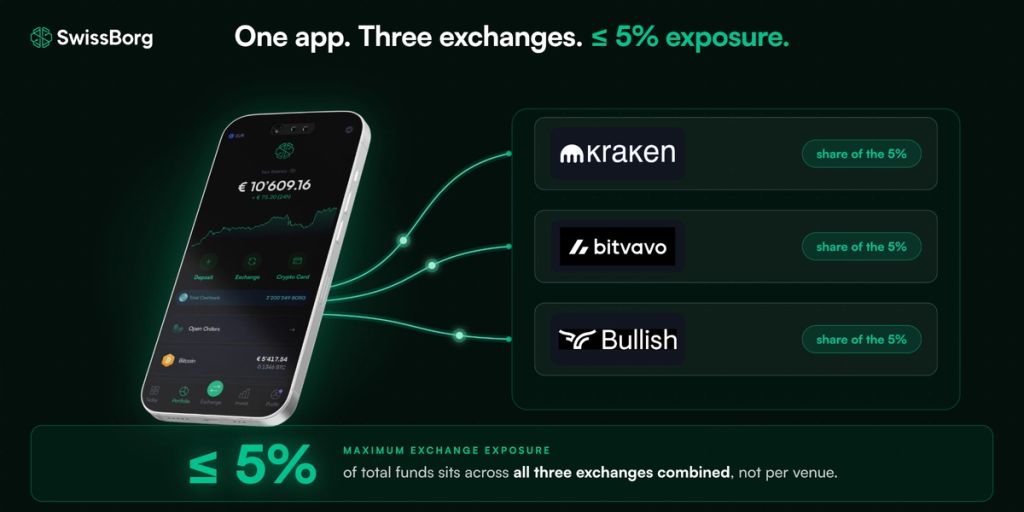
We do not simply connect to any CEX platform; we rigorously vet and integrate with only top-tier venues: Kraken, Bitvavo, and Bullish.
These partners are not only highly competent at providing access to the necessary markets, but they are also well regarded internationally and adhere to the strictest regulatory standards, including MiCA compliance.
With just one SwissBorg account, you gain seamless access to all of these premium venues, unlocking institutional-grade liquidity from platforms like Bullish, without ever needing to manage multiple logins or onboard separately with each venue.
By drawing on these carefully selected partnerships, our infrastructure is designed to ensure that only a very small fraction of your assets are ever held at centralised exchanges (less than 5% combined). We actively manage this liquidity and maintain strict internal exposure limits across these tier-one venues.
The remainder of user funds are securely held with highly trusted custody providers.This approach is designed to reduce your counterparty risk while keeping your capital available for execution when the Smart Engine requires it.
40+ Platforms, 5 Chains, Zero Bridges

Navigating the decentralised finance (DeFi) landscape traditionally requires managing multiple wallets, paying volatile gas fees, and relying on high-risk cross-chain bridges.
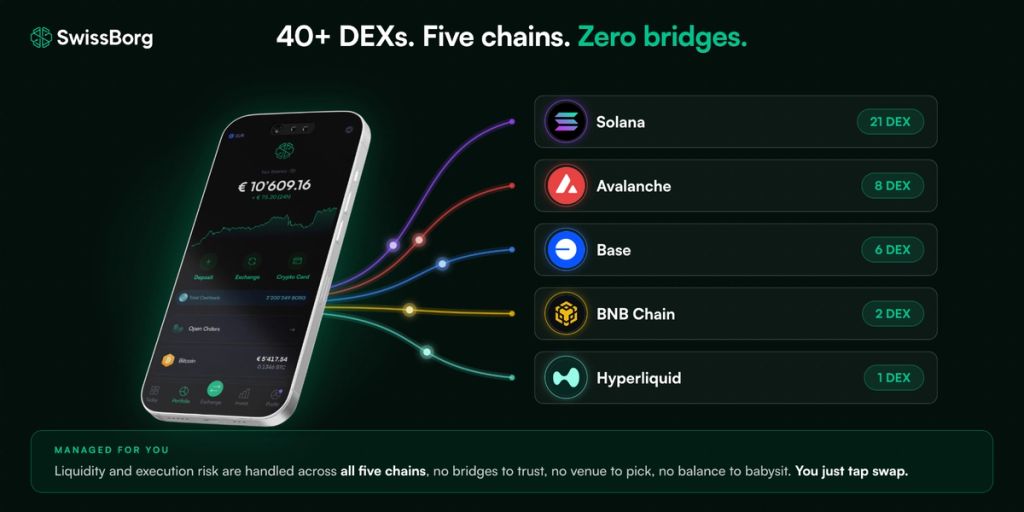
The SwissBorg Meta-Exchange removes these technical barriers. We do not rely on a single liquidity source. Instead, the SwissBorg app aggregates liquidity from leading CEXs and connects seamlessly to over 40 Decentralised Exchanges (DEXs) across five different blockchain networks (Solana, Base, BNB Chain, Avalanche, and Hyperliquid).
When you tap 'Exchange', you are trading with the entire crypto ecosystem at once. Liquidity and execution risks are handled comprehensively across all five chains. There are no bridges to trust, no specific venue to pick, and no individual balances to monitor. You simply tap to swap.
The Smarts Behind "Anything-to-Anything"

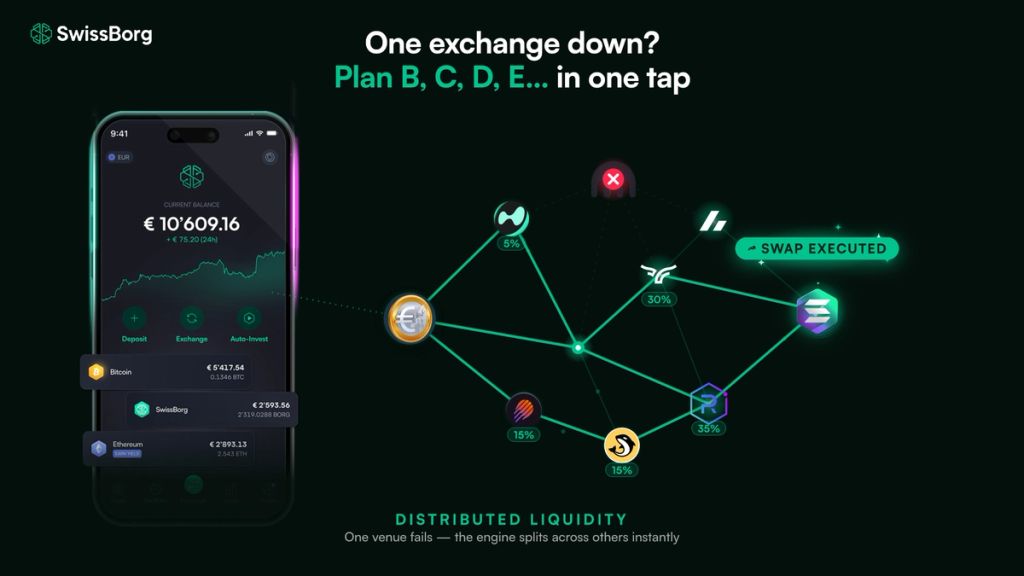
At the core of the MEX is the Smart Engine. Think of it as an institutional-grade liquidity aggregator.
SwissBorg currently supports over 400 crypto assets and 12 fiat currencies. If you were trading on a traditional exchange order book, you would be strictly limited to the trading pairs they have decided to list.
If a direct pair did not exist, you would be forced into multiple manual trades, incurring double (or more) fees and increasing your exposure to price volatility.
The MEX allows you to swap any supported asset for any other asset in a single tap.
How We Make Complex Routing Simple
When you request a trade, the Smart Engine instantly creates a Synthetic Pair. In milliseconds, it jumps into action with:
- Analysis: Scans all of our connected CEXs and DEXs.
- Smart Splitting: It does not just look for a single route; it calculates the total financial impact. Even on smaller trades, the Engine may determine that a direct pair is inefficient.
- The Path: It sees a better way. The Smart Engine might convert your CHF into EUR (where liquidity is deeper and spreads are tighter), and then use that EUR to buy the token. It might also split your trade through multiple paths, all to access the best liquidity for you.
- Execution: It executes this multi-hop trade instantly.
Without this intelligent routing, specific trades would either fail entirely or suffer from severe price impact due to thin order books.
Why You Might See "Unknown" Tokens in Your Route
You might check your history and see that your trade was routed through a stablecoin or a token you are unfamiliar with. These tokens are never held by you and exist only momentarily within the execution path. It is where the Smart Engine shows just how sophisticated it is.
The MEX may have routed your trade through "bridge assets" (like a stablecoin or a specific token) or split it into multiple chunks to avoid moving the market price against you. This is intentional, and it works in your favour.
The engine identified that a specific token pair on a specific exchange had the deepest liquidity or price advantage at that exact second. It used that token (or tokens) as a temporary stepping stone to transport your value efficiently, minimising slippage and maximising the final amount of crypto you received.
This process is not just for "whales" or massive orders.
Whether you are trading €50 or €500,000, the Smart Engine treats your capital with the same precision.
Transparent Execution and Fees
A common misconception regarding complex routing is that multiple steps equal multiple fees. This is fundamentally incorrect within the SwissBorg MEX.
You pay a single, transparent fee for the execution of your trade. The Smart Engine automatically factors in platform fees, spreads, depth of liquidity, and potential price impact into its calculation before executing.
If it routes your trade through an intermediate asset, it does so because that route is calculated to deliver a better final execution price than forcing a direct, illiquid pair.
SwissBorg: Engineered for Security
The strength of the SwissBorg MEX is its resilience. By diversifying liquidity sources across more than 40 platforms, we reduce single points of failure. If one exchange experiences an outage, the Smart Engine reroutes your trade through the remaining operational venues.
You receive access to deep global market liquidity, the simplicity of a single interface, and the engineering standards SwissBorg is built on.
Meta-Exchange Frequently Asked Questions (FAQ)
The SwissBorg Meta-Exchange (MEX) is a liquidity aggregation system that connects your SwissBorg account to more than 40 decentralised exchanges and a selection of top-tier centralised exchanges across five blockchain networks. It allows you to swap any supported asset for any other in a single tap, without managing multiple wallets or bridges.
SwissBorg spreads liquidity across many venues rather than concentrating it on a single exchange, and keeps only a very small fraction of user assets at centralised exchanges at any time. The remainder is securely held with highly trusted custody providers. This is designed to reduce counterparty risk compared with holding funds on a single platform.
A Synthetic Pair is created automatically by the Smart Engine when a direct trading pair between two assets is illiquid or does not exist. The engine routes your trade through the most efficient intermediate asset (or assets), combining the steps into a single transaction with one transparent fee. It may even split your trade into multiple chunks to avoid moving the market price against you.
No. You pay one transparent SwissBorg exchange fee regardless of how your trade is routed. The Smart Engine only uses an intermediate route when it results in a better final execution price than a direct pair.
The Meta-Exchange currently connects to five networks: Solana, Base, BNB Chain, Avalanche, and Hyperliquid.
Continue the conversation:
X | Instagram | YouTube | Discord | Telegram
Crypto assets are highly volatile. You risk losing all invested capital. This article is for informational purposes only and is not financial advice.You can learn more about risks associated with crypto assets at https://swissborg.com/legal/list-of-risks
Date modified: