




When investing in crypto, the fee and preview price displayed on screen tells only part of the story.
What ultimately matters is the amount of the requested asset delivered after the complete order has been executed.
That outcome depends heavily on liquidity: how much of an asset is available to buy or sell at each price across the market.
A conventional exchange generally restricts an order to the liquidity available on its own platform. The SwissBorg Meta-Exchange (MEX) takes a different approach. The MEX connects liquidity across more than 40 centralised and decentralised venues, and the Smart Engine analyses them to construct a precise execution plan for the selected assets and amount.
That plan does not have to rely on one venue, one order book, or even one route. The Smart Engine can divide an order into several portions, execute them through different venues and intermediate assets, and efficiently bring the results together into the asset you requested.
Its aim is to identify the execution plan expected to deliver the highest amount of the requested asset from SwissBorg’s connected markets for the complete order.
One request. Many potential routes. One delivered result. Simply Smarter.
What Exactly Is Liquidity?
Liquidity describes how easily an asset can be bought or sold without the transaction significantly affecting its price.
On a centralised exchange, liquidity is organised through an order book, which contains the active offers to buy and sell an asset at different prices. A deeply liquid order book has substantial volume available close to the current market price. A shallow order book may have only a small quantity available at its best displayed price.
Decentralised exchanges work differently, but the principle is similar. You trade against liquidity available within pools or onchain order books, and the depth of that liquidity affects the price you receive.
Crypto liquidity is fragmented across centralised exchanges, decentralised exchanges, individual order books and liquidity pools, different trading pairs, and even separate blockchain networks. No single venue necessarily provides the deepest liquidity for every asset, order size, and market condition.
Why Liquidity Affects the Amount Delivered
Imagine an exchange displays a token price of €10. That does not necessarily mean your entire order can be completed at €10. There may be only a small quantity available at that price.
Your order might be filled like this:
- the first portion at €10;
- the next portion at €10.10;
- another portion at €10.20; and
- the remainder at €10.35.
As the order consumes the liquidity available at each price, it moves through progressively less favourable levels. This is known as price impact.
The difference between the expected price and the price ultimately achieved is known as slippage. Although the displayed price was €10, the complete order may therefore execute at a higher average price, meaning the same amount of money buys fewer tokens.
This is why an isolated headline price or fee is not the most important measure.
The more useful measure is the total amount of the requested asset delivered after the complete exchange has been executed, taking into account available liquidity, spreads, price impact, the execution route, costs, and applicable fees.
The Four Risks of Relying on One Order Book

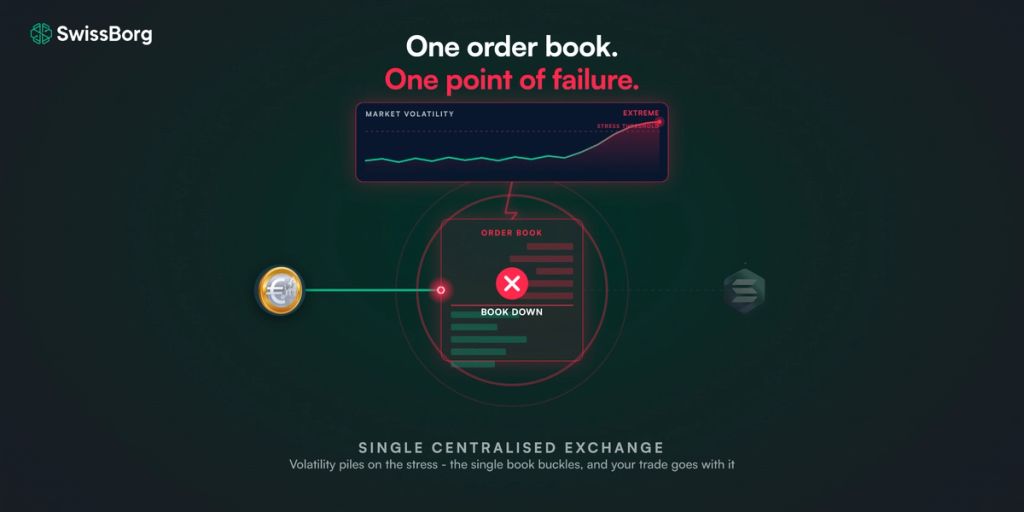
A conventional exchange generally executes using only the markets available on its own platform. That creates several limitations.
1 - The Displayed Price May Apply to Only Part of the Order
An order book can show an attractive price while having insufficient liquidity to complete the full transaction at that level. Once the available volume has been used, the remainder executes at less favourable prices.
2 - Better Liquidity May Exist Elsewhere
Prices, spreads, and market depth vary between venues. Restricting an order to one platform means you cannot benefit from liquidity available on other markets.
3 - A Direct Trading Pair May Not Exist
A venue may not offer a direct market between the two assets you want to exchange, forcing you to sell into a stablecoin or major crypto asset and complete one or more additional trades manually, introducing further spreads, fees, and market exposure.
4 - The Exchange Depends on One Platform
If the venue experiences a connectivity issue, reduced liquidity, or a temporary disruption, there may be no alternative order book available within that platform.
How the SwissBorg MEX Accesses Liquidity Across Multiple Markets

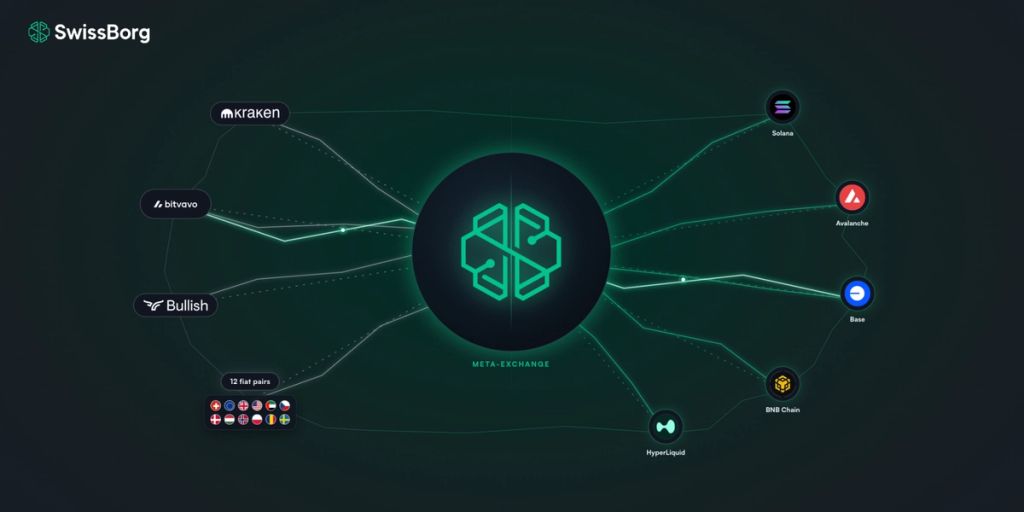
The SwissBorg Meta-Exchange is not restricted to one internal order book. It connects liquidity from three centralised exchanges and decentralised exchanges across five blockchain networks, amounting to more than 40 connected trading venues in total.
The distinction between the MEX and the Smart Engine is important. The MEX provides access to the connected markets. The Smart Engine determines how their liquidity should be combined.
When you request an exchange, the Smart Engine evaluates the available execution options for your selected assets and order size. It considers the best available prices across SwissBorg’s connected markets, but it does not simply select the venue displaying the most attractive quote. Instead, it calculates how the complete order can be executed to maximise the amount of the requested asset delivered.
One Request Can Become Many Routes
One tap in the SwissBorg app does not necessarily mean one underlying trade, one venue, or even one route.
Depending on the available liquidity, the Smart Engine can divide your order into several portions, send those portions through different venues and intermediate assets, and bring the resulting executions together into the asset you requested.
Consider why splitting an order can deliver more. Suppose one venue offers the best available price from SwissBorg's connected markets, but has enough liquidity for only 25% of the order. Sending the entire order there could consume the strongest available offers before forcing the remaining 75% through progressively worse prices.
The Smart Engine may calculate that a higher total amount can be delivered by executing 25% through the first order book, sending another portion through a second venue, routing part through an intermediate asset, and using a decentralised liquidity pool for the remainder. Each route contributes to the same final exchange.
The same logic applies when no direct trading pair exists. The Smart Engine can construct a multi-step route between assets that do not have a sufficiently liquid direct market. One part of an exchange might route through USDC (USD Coin), while another passes through SOL (Solana) and a decentralised liquidity pool because that route is expected to produce a stronger delivered result.
You still make one simple one tap request: Asset A → Asset B
Behind the scenes, the Smart Engine may construct several routes and perform several trading steps before delivering Asset B. You do not need to identify those markets, hold the intermediate assets, or execute each trade manually.
The objective is not to select the platform displaying the lowest price for a small fraction of the order. It is to determine which route, or combination of routes, is expected to deliver the highest total amount of the requested asset for the complete order.
The Delivered Amount Is What Matters

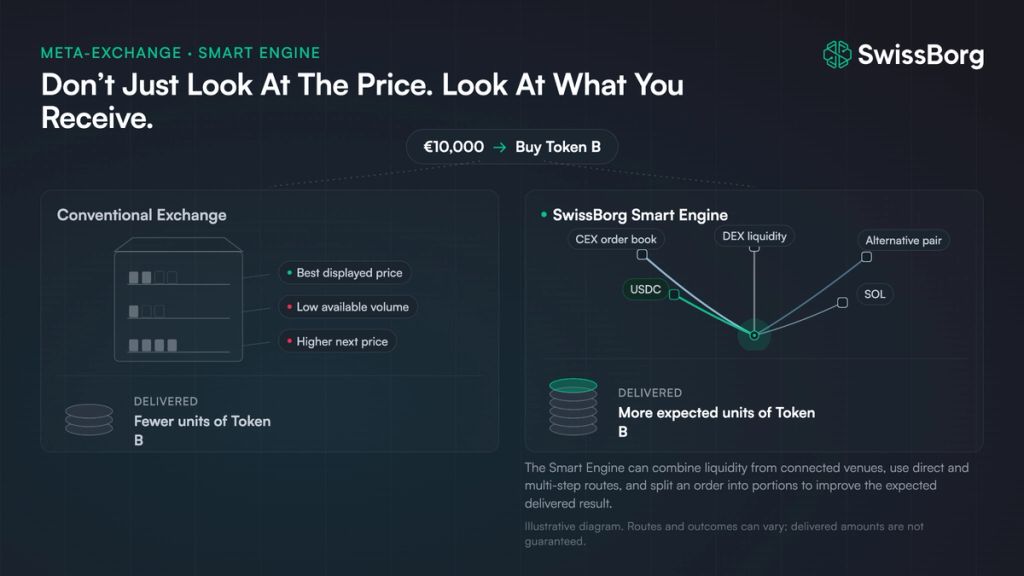
Two platforms can display similar headline prices but deliver different amounts for the same order. The difference may be caused by the depth of available liquidity, spreads, price impact, the size of the order, execution fees, the use of intermediate assets, and the number and quality of available routes.
This is why the amount received is more meaningful than an isolated token price.
A conventional exchange effectively asks: what can this one order book deliver? The SwissBorg Smart Engine asks: how can the liquidity available across our connected markets be combined to deliver the highest expected amount for this complete order?
More Routes Mean Less Dependence on One Venue
Accessing multiple venues is primarily about finding stronger liquidity and improving the delivered amount. It can also provide more execution options when conditions change.
If one order book becomes unavailable, loses liquidity, or no longer offers the expected execution conditions, another connected route may still be available.
Crypto prices and liquidity can change rapidly, particularly during extreme volatility or widespread market disruption. Access to multiple venues does not guarantee that every exchange will execute under all market conditions.
However, drawing on multiple connected markets dramatically reduces dependence on any single exchange, order book, or liquidity pool, and may improve reliability for your trades under challenging conditions.
More Than 75,000 Exchange Combinations
SwissBorg supports more than 75,000 possible fiat-to-crypto, crypto-to-fiat, and crypto-to-crypto asset combinations. For the specific assets and amount selected, the Smart Engine calculates the relevant direct and multi-step routes available across SwissBorg's connected markets.
You do not need to compare several order books manually, maintain accounts across multiple exchanges, execute intermediate trades yourself, manage separate wallets and gas tokens, or operate blockchain bridges directly.
You select what you have, what you want, and how much you want to exchange. The Smart Engine handles the complexity underneath.
One Tap. Multiple Routes. One Delivered Result.

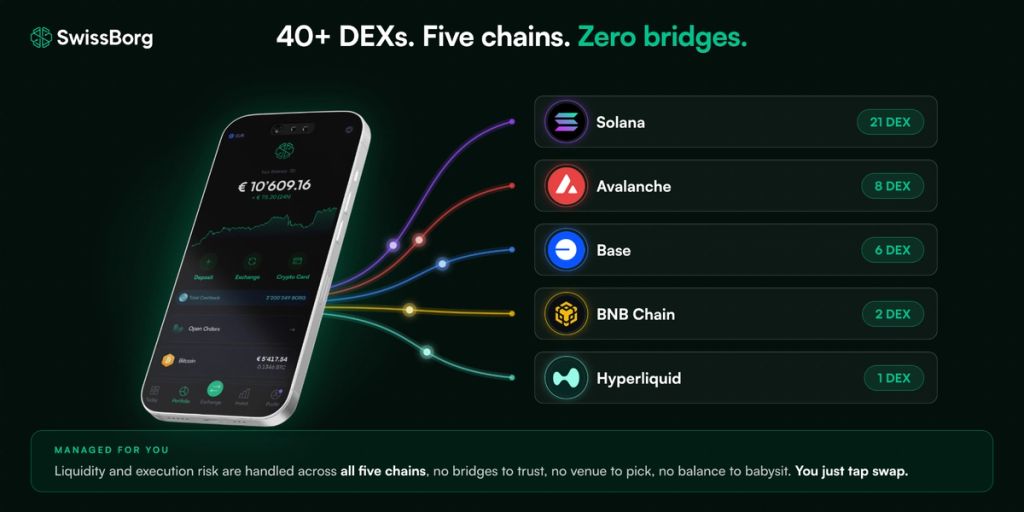
A displayed price is only as meaningful as the liquidity available behind it. A conventional exchange restricts an order to the liquidity within its own markets.
The SwissBorg MEX accesses liquidity across more than 40 connected venues, while the Smart Engine can calculate direct and multi-step routes, divide an order where appropriate, and combine multiple sources of liquidity to maximise the amount of the requested asset delivered from SwissBorg’s connected markets.
You make one request. The Smart Engine constructs the execution plan.
Simply Smarter.
Open the SwissBorg app and see the estimated amount you will receive before you confirm any exchange. One tap. Multiple routes. One delivered result.
Meta-Exchange and Smart Engine FAQ
The Meta-Exchange is SwissBorg's network of connected centralised and decentralised markets. The Smart Engine analyses the liquidity available across those markets and constructs an execution plan for the selected assets and order size.
Slippage is the difference between the expected price of an exchange and the price at which it is actually executed. It can occur because market prices move during execution or because an order consumes the liquidity available at the best prices.
The displayed price may apply to only part of an order. The delivered amount reflects the result after the complete order, available liquidity, spreads, price impact, execution route, costs, and applicable fees have been considered.
Yes. Depending on the available liquidity and order size, the Smart Engine can divide an exchange into several portions and execute them through different venues, assets, and routes. The resulting portions are then brought together into the asset you requested.
The Smart Engine can construct a multi-step route using one or more intermediate assets. You still make one exchange request, while the underlying trading steps are handled automatically.
Extreme market conditions can affect pricing, liquidity, and connectivity on individual platforms. Accessing several connected markets provides more execution options, which may significantly improve reliability under challenging market conditions.
No. You cannot initiate direct fiat-to-fiat exchanges. Supported fiat currencies can be exchanged into crypto assets, while supported crypto assets can be exchanged into fiat or other crypto assets.
The Meta-Exchange currently connects to five networks: Solana, Base, BNB Chain, Avalanche, and Hyperliquid.
The Meta-Exchange connects to more than 40 centralised and decentralised venues in total, including three centralised exchanges and decentralised exchanges across five blockchain networks.
Continue the conversation:
X | Instagram | YouTube | Discord | Telegram
Crypto assets are highly volatile. You risk losing all invested capital. This article is for informational purposes only and is not financial advice.You can learn more about risks associated with crypto assets at https://swissborg.com/legal/list-of-risks
Date modified: