







Key Takeaways
Risk Level: LOW
- The strategy stakes ETH via Lido, the leading Ethereum liquid staking protocol by ETH staked and TVL.
- Users gain staking yield on ETH while keeping the possibility to exit. Under normal conditions, Lido withdrawals have typically completed within a few days, but the Ethereum exit queue can extend to several weeks (recently up to ~45 days), which materially increases liquidity risk
- Yield comes from Ethereum Proof-of-Stake rewards only, with no additional farming or incentive layers, making it structurally “real yield”.
- The strategy is operationally simple: stake ETH → receive stETH (or wstETH at protocol level) → accrue staking rewards → request withdrawals when exiting.
- Although Lido is open-sourced, audited and covered by a bug bounty program, smart contract and protocol risk cannot be eliminated. An exploit at Lido level would directly impact the strategy.
- As with any ETH staking, investors are exposed to slashing risk on the underlying validators and to exit-queue / liquidity risk if many stakers exit simultaneously or if Ethereum experiences stress
Risk Checklist
The predominant risks for this ETH staking strategy on Lido are:
- Smart contract / protocol risk: Lido contracts, staking router, withdrawal queue
- ETH staking & slashing risk
- Liquidity & exit-queue risk: withdrawal delays in stress, potential discount of stETH vs ETH on secondary markets
- Peg risk: stETH vs ETH
1. Strategy explained
Users deposit ETH into an Earn strategy that allocates funds to Lido on Ethereum.
- At protocol level, ETH is deposited into Lido contracts and converted to stETH on a 1:1 basis at the time of deposit.
- stETH represents a claim on staked ETH plus accumulated staking rewards. Rewards accrue continuously and are reflected by a rebasing balance.
- Validators selected by Lido participate in Ethereum Proof-of-Stake and earn rewards that, net of Lido’s 10% fee, are passed through to stETH holders.
- To exit, stETH is submitted to Lido’s withdrawal queue and redeemed for ETH. There is no fixed lock-up period at protocol level but a cooldown period is present and depends on the exit queue.
2. Strategy Risks
Trust Score
Lido has been assigned a SwissBorg Trust Score of Green.
Lido is one of the most established liquid staking protocols in DeFi:
- It has been live since December 2020, with staked ETH supply in the millions of ETH and TVL in the tens of billions of USD.
- Core contracts are open-sourced, audited and covered by an Immunefi bug bounty program.
- Lido routes stake across a diversified set of professional node operators, but concentration risk remains.
SwissBorg Trust Score: Green
Rationale: large, battle-tested protocol with extensive integrations and a robust security framework, while retaining non-negligible concentration, on-chain and governance risks.
Protocol Risks
Project Continuity Risk
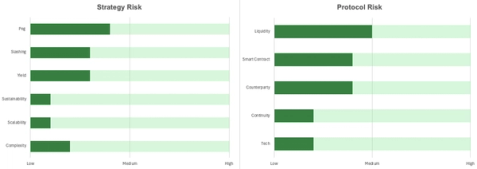
Score: 2/10 (Low)
- Lido is the leading ETH liquid staking protocol by TVL, with staked ETH representing a material share of the total network stake.
- It is integrated across major DeFi protocols (Aave, Curve, Balancer and others), which reinforces network effects but also introduces inter-protocol dependencies
- Continuity risk primarily stems from:
- Potential regulatory changes targeting large liquid-staking providers
- Governance mis-configuration or capture at DAO level
Overall, near-term operational continuity risk is viewed as low but not zero.
Counterparty Risk
Score: 4/10 (Moderate)
- Users rely on Lido’s DAO and operators to run the staking router, oracle system and withdrawal contracts correctly over time.
- Governance decisions (or mismanagement) can change parameters, slow down, limit or temporarily pause redemptions, even if Ethereum itself is functioning normally.
- Operational failures at validator, oracle or protocol level could delay exits or create mismatches between expected and actual withdrawals.
- This dependency on Lido’s ongoing operation and governance means counterparty risk is not negligible, even though assets are held on-chain via validators.
Smart Contract Risk
Score: 4/10 (Moderate)
The strategy depends on several smart contracts: Lido’s staking router, stETH logic, withdrawal contracts, and the oracle reporting system. Although Lido is audited, open-source, and protected by a bug bounty, vulnerabilities or faulty upgrades could impact stakers.
The protocol also inherits risk from Ethereum’s consensus-layer logic and from broad DeFi composability, since stETH is widely integrated. Overall, the track record is strong, but contract and integration risk cannot be eliminated.
Liquidity Risk
Score: 5/10 (Moderate)
Liquidity risk is significant because exiting staked ETH is constrained by:
1. Ethereum Validator Exit Queue (protocol-level bottleneck)
- ETH withdrawals depend on the global Ethereum exit queue, which can grow dramatically during periods of high exit demand.
- Exit times can fluctuate from a few days to over 40–45 days, depending on how many validators are leaving the network.
- This queue is external to Lido and cannot be accelerated, all stakers (including Lido) are subject to the same throughput limits.
2. Lido Withdrawal Mechanics
- After Lido requests validator exits, the protocol must wait for ETH to be released.
- During heavy market stress, stETH/ETH can trade at a discount on DEXs, making secondary-market exits costly.
Liquidity risk is therefore not negligible.
While the strategy is technically “liquid staking,” exits rely on Ethereum’s slow validator exit pipeline and Lido’s redemption process. During peak congestion or market panic, users should expect material delays (weeks rather than days).
Strategy Risks
Complexity
Score: 2/10 (Low)
- The strategy uses one chain (Ethereum), one protocol (Lido) and a simple operation set: stake ETH, accrue rewards, request withdrawal.
- Users are not exposed to leverage, multiple DeFi layers, or complex hedging.
The underlying staking and redemption mechanics are conceptually more complex than a simple deposit, but operationally the strategy remains straightforward.
Scalability
Score: 1/10 (Low)
- Lido already stakes millions of ETH, and Ethereum’s design allows for large staking volumes.
- The marginal impact of additional SwissBorg deposits is negligible relative to Lido’s total TVL and network capacity.
Scalability constraints are not expected to be binding under foreseeable strategy sizes.
Sustainability
Score: 1/10 (Low)
- Yield is derived solely from Ethereum staking rewards, not from liquidity mining emissions or short-lived incentive programmes.
- As long as Ethereum PoS remains active and validators earn rewards, the yield source is structurally sustainable, although its level will fluctuate with network conditions (e.g. total ETH staked, fee levels, MEV).
The economic model is therefore considered highly sustainable, with variability coming from the protocol (Ethereum) rather than external incentives.
Yield Risk
Score: 3/10 (Low-Moderate)
- Yield depends on:
- Overall ETH staking participation;
- On-chain transaction activity and priority fees;
- MEV conditions;
- Validator performance and slashing/penalty events.
There is no guaranteed minimum return, APY can move both higher and lower, particularly around major network or market events.
Volatility of APY is expected to be moderate but persistent over time.
Slashing Risk
Score: 3/10 (Low-Moderate)
Slashing is a protocol-level penalty applied to Ethereum validators for downtime or incorrect behaviour. While individual events are typically small, a correlated slashing event across several operators would result in losses to stETH holders.
Lido mitigates this through a diversified set of professional node operators, multiple client implementations, and continuous monitoring. Slashing events to date have been minimal, but fat-tail risk remains inherent to ETH Proof-of-Stake.
Peg Risk
Score: 4/10 (Moderate)
- stETH is designed to track the economic value of staked ETH plus rewards, not a strict 1:1 instant cash-redeemable claim at all times.
- In normal markets, stETH usually trades very close to ETH, but temporary discounts have occurred when secondary-market liquidity was stressed or exit queues were uncertain.
Peg risk is considered limited but can be relevant in the short term during systemic DeFi stress.
3. Conclusions
This strategy provides direct exposure to ETH staking via Lido, the leading liquid-staking protocol on Ethereum. It is structurally simple, generates “real yield” from Ethereum Proof-of-Stake rewards, and relies on a battle-tested, widely integrated protocol.
The main residual risks are on-chain and structural: smart contract and governance risk at Lido level, liquidity risk driven by the Ethereum validator exit queue (which can extend to several weeks in periods of stress), and staking-related risks such as slashing and temporary stETH/ETH peg deviations.
Overall, the risk profile is assessed as Low, suitable for investors who already understand ETH staking mechanics, accept on-chain smart contract and liquidity risks, and are comfortable with variable APY and potentially extended exit times in return for a moderate, sustainable yield on ETH.
Indicative Overall Risk Rating: Low.
Date modified: