






Compliance Infrastructure On-Chain: An In-Depth Look at Wecan's Utility Token
The Wecan token is now supported on SwissBorg.
This note presents the project behind it: what Wecan Group does, how the token is designed to capture the platform's usage, where the rollout stands, the trajectory the company models, and the key points to weigh.
It draws on public announcements, on-chain data and information provided by Wecan.
Wecan at a Glance
| Token | Wecan, the utility token of the Wecan compliance platform |
| Network | Solana |
| Max supply | 6 billion, hard cap, fully in circulation |
| Issuer | Wecan Group SA, Geneva, founded 2015 |
| Majority shareholder | SEALSQ Corp (Nasdaq: LAES) |
| Clients | More than 100 banks, insurers, financial intermediaries and other regulated organisations |
A Real Business First
Compliance is one of the heaviest recurring costs in regulated finance, and Wecan has been selling software that addresses it from Geneva since 2015
Its core product turns KYC and compliance checks into audit trails anchored on a blockchain: each verification produces a cryptographic fingerprint that lets an institution demonstrate to its regulator, at any time, that due diligence was performed and has not been altered since.
In 2026 Wecan launched its AI Compliance Copilot and began migrating its existing products onto it.
Adoption is the strongest part of the story. Per the joint announcement of 27 August 2026, Wecan's solutions are used by more than 100 banks, insurers, financial intermediaries and other regulated organisations. Publicly cited relationships over the years include Pictet, Lombard Odier, Barclays Private Bank Switzerland and Edmond de Rothschild. These institutions pay recurring licence fees in Swiss francs, per the company.
The corporate backing is unusual for a token of this size. SEALSQ Corp, a Nasdaq-listed semiconductor group and Wecan's majority shareholder, has committed CHF 5 million through its SEALQUANTUM fund to accelerate the Copilot and Wecan's post-quantum security roadmap.
Wecan will also receive a grant from Hedera, as announced in December 2025 to build quantum-resistant compliance and identity infrastructure.
The demand backdrop is structural: KYC, AML and frameworks such as MiCA keep expanding what regulated institutions must verify, and how often.
How the Wecan Token Is Designed to Work
The Wecan token has one job: every audit trail the platform anchors consumes tokens. The design question is how enterprise usage becomes token demand, and Wecan's token economics answer it with a model built for regulated clients.
Institutions pay for their compliance activity at fixed prices in Swiss francs, the way regulated clients expect to be billed. The tokens the platform consumes are then acquired on the market, out of an acquisition budget driven by that usage revenue. Platform usage therefore translates into recurring token demand, with a stability profile closer to enterprise procurement than to retail flows.
Two further mechanisms complete the design. First, a fraction of the tokens acquired is permanently burned; the proportion is a policy parameter the company will communicate separately.
The 6 billion cap is fixed, with no re-issuance. Second, demand ramps with adoption: the model follows the trajectory along which client institutions are won, over a five-year horizon.
Wecan’s Five-Year Model
The trajectory below is Wecan's own hypothesis, published in its token economics note. It is not a SwissBorg projection.

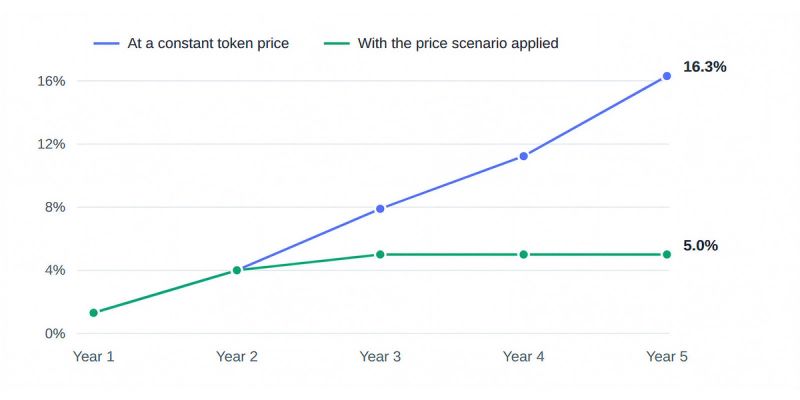
Annual Buy Pressure: Constant Price vs. Price Scenario
Wecan models the ramp-up as follows. Anchoring volume grows roughly tenfold over five years as the target installed base comes online: a modest first year while early institutions complete their integration, an acceleration mid-period as deployments accumulate, and steady state in year five.
The chart below translates that ramp-up into annual token purchases, measured against max supply, under the two price assumptions the company presents.
On the company's assumptions, annual token purchases would climb to roughly 16% of max supply by year five if the token price never moved. Under the illustrative price path in the same note, higher usage is reflected in the token price rather than in the number of tokens bought, so annual purchases level off at around 5% of max supply, and cumulative burns over the period run from about 1% under that price path to about 2% at a constant price.
Either way the mechanism points in the same direction: if adoption follows Wecan's plan, verification generates recurring, usage-driven demand against a supply that can only stay fixed or shrink.
The company states these figures are internal, unaudited management estimates, based in part on contracts still under negotiation, and are illustrative rather than a forecast.
What Is Live Today, and What Comes Next
| In place today | Ahead on the roadmap |
| More than 100 regulated institutions using Wecan's solutions | Usage-based on-chain billing, deployed progressively |
| Recurring licence revenue billed in Swiss francs, per the company | Token purchases tied to client usage, which begin with the billing deployment |
| A 6 billion hard cap, fully circulating, with the contract verified on-chain | Burns, which activate with the same deployment |
| Majority backing by a Nasdaq-listed group, and a Hedera grant | A public purchase wallet allowing anyone to verify buying and burning on-chain |
The demand model above is therefore a design, not yet an observable flow. On-chain activity so far reflects technical anchoring rather than market demand, and billing in tokens phases in as the deployment completes and client contracts migrate onto it.
Supply and Holders
The supply side is simple. Six billion tokens, hard-capped and all in circulation: there is no vesting schedule ahead, no emissions and no future unlock events.
The largest holders are long-standing company shareholders and team members, positioned since the presale, and Wecan is working on a programme that encourages long-term holding.
Combined with the burn mechanism, the supply can only stay fixed or shrink over time.
Milestones to Watch
Every step of this thesis is publicly verifiable. The evidence to track:
- Activation of usage-based on-chain billing, and the migration of the first existing clients to it. This is the moment the model turns from design into measurable flow.
- Publication of Wecan's purchase wallet, and the first burns.
- Communication of the burn ratio.
- Growth of the installed base beyond the 100+ institutions announced.
Key Risks
- Execution and timing. The demand model activates with the on-chain deployment; if deployment or contract migration takes longer than planned, token demand builds later.
- Dependence on the issuer. Token purchases, the burn ratio and the disclosure cadence are decisions of the company.
- Concentration. A significant share of supply is held by long-standing shareholders and team members without lock-ups.
- Market risk. Wecan is an early-stage token with limited liquidity; expect sharp price moves in both directions.
- Model assumptions. The trajectory figures are unaudited management estimates, based in part on contracts still under negotiation.
Bottom Line
Wecan pairs an established Swiss regtech business, more than 100 regulated institutions and recurring Swiss-franc revenue, with a token designed so that platform usage becomes recurring market demand against a supply that can only stay fixed or shrink.
The mechanism activates with the on-chain deployment, and every step of it will be verifiable on-chain. The milestones above are the evidence to follow.
Important information. This note is provided for information purposes only. It is not investment advice, a personal recommendation, or an offer to buy or sell any crypto asset. Crypto assets are volatile: their value can go down as well as up, and you may lose the full amount you allocate. Past performance is not a reliable indicator of future results. Trajectory figures attributed to WecanGroup SA are illustrative, unaudited management estimates and not forecasts. Sources: SEALSQ and Wecan announcements of 27 August 2026 and 17 December 2025; WecanGroup SA, Wecan Token, Token Economics Principles, 28 August 2026; Wecan white paper 3.0, December 2025.
Date modified: